
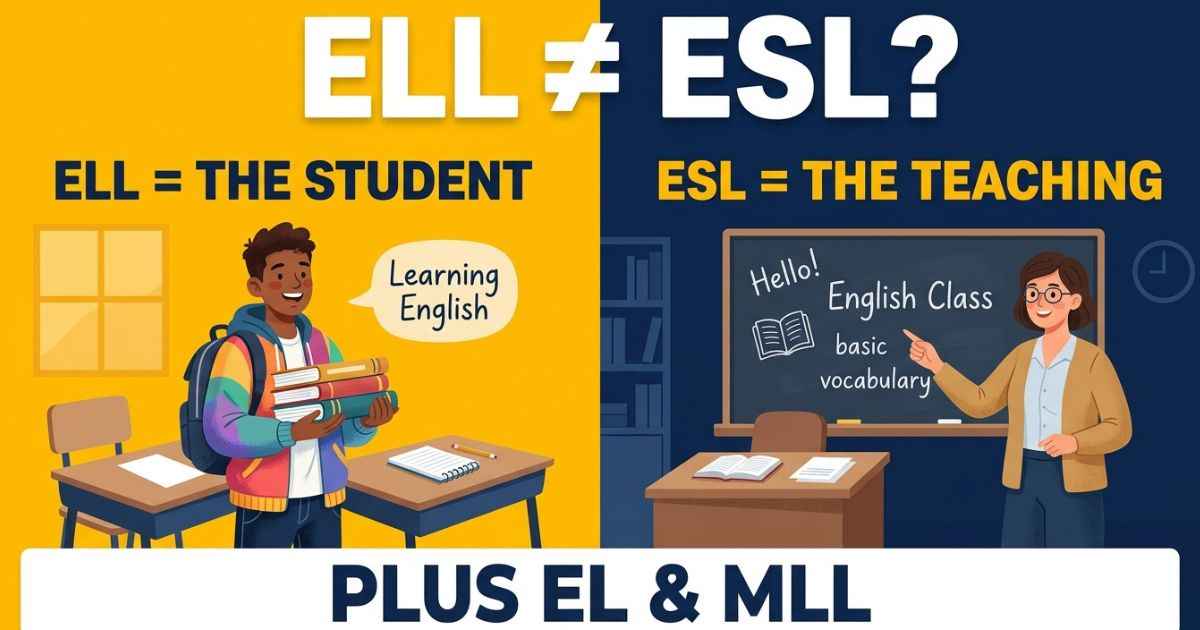
ELL stands for English Language Learner. ELLs are students in U.S. schools who are still learning English while they learn school subjects. Schools also use other labels, such as EL, ESL, and MLL, and that can get confusing. This guide explains what each term means, how schools find ELLs, and what help can look like for students and families.
What Does ELL Mean in Education?
ELL is short for English Language Learner. It names a student who is still building English skills. The student may speak another language at home and may be new to English.
Here is a simple example. A student may understand the math but struggle to read the word problems. That student is learning two things at once: the subject and the language.
WIDA, a group that works on language education, uses the term multilingual learner as an inclusive, strengths-based label. ELL also appears in older education materials and some school resources.
Who Is Considered an English Learner Under Federal Law?
The federal term is English learner, or EL. It comes from the U.S. Code, which is the main collection of federal laws. The 2023 edition describes an English learner as a person who:
- Is between 3 and 21 years old
- Is enrolled in elementary or secondary school, or getting ready to enroll
- Meets the language-background rules in the law
- Has trouble with English that may affect meeting academic standards, doing well in class, or taking part in society
This is the federal definition. Federal law requires states to use standardized statewide procedures to identify and exit English learners. Districts apply their state’s procedures, but screening tools and score requirements can differ between states.
ELL vs. EL vs. ESL vs. MLL: What Is the Difference?
These terms are close, but they are not all the same. Here is a quick guide.
| Term | What it means | Where you see it |
|---|---|---|
| ELL | English Language Learner. A student who is learning English. | School resources and education writing |
| EL | English learner. The formal term in federal law. | The U.S. Code |
| ESL | English as a second language. Usually names the teaching or program. | Schools and program names |
| MLL | Multilingual learner. A newer label used by some groups and states. | Some states, WIDA, and education groups |
| Emergent bilingual | Another label used in education. | Education writing |
The big idea is simple. ELL usually describes a student. ESL usually describes the instruction. Do not treat them as always the same.
States do not agree on one label either. SupportEd’s 2022–23 research found that 30 states and Washington, D.C., used EL only. Eight states combined EL and ELL. Seven combined EL with ML or ELL with ML/MLL. Three used ML only, and one used EL and EB. This is not a current 2026 state count.
Some educators prefer labels that focus on a student’s strengths. TESOL, a teaching group, says the best label can depend on the setting. In this guide, ELL is used because it is the term most people search for.
Are ELL Students Immigrants?
ELL status is about English skills. It does not tell you a student’s immigration status.
The federal definition, as described above, looks at age, school enrollment, language background, and English difficulties. Understood, a site for families and teachers, also warns teachers not to guess a student’s immigration status or background. A teacher should learn about each student instead of assuming.
How Are ELL Students Identified and Assessed?
Federal law requires states to use standardized statewide procedures to identify and exit English learners. Districts apply their state’s procedures, but screening tools and score requirements can differ between states. In general, the process has four parts.
- Collect home-language information. Schools often use a home-language survey. This is a form that asks which languages a student uses with family and others.
- Screen English skills. One example is the WIDA Screener. It helps schools find students who may qualify for English language development services.
- Look at other evidence. WIDA says screener results should be read with other facts, such as school records and home-language information.
- Make a decision. The district applies the state’s procedures to decide if the student gets English language services.
Schools must assess students who may qualify within 30 days of enrollment under the applicable Title III requirements.
A home language other than English does not decide the answer by itself. Schools look at more than that.
Teachers may also learn about a student’s earlier schooling, reading skills in the home language, interests, and goals. Understood lists these as helpful facts for teachers.
What Does the WIDA Screener Measure?
The WIDA Screener looks at four skills:
- Listening
- Speaking
- Reading
- Writing
The WIDA Screener helps identify students who may need language services. WIDA ACCESS is the separate annual assessment that monitors English-language development.
How Many ELL Students Are in U.S. Schools?
NCELA, a national clearinghouse supported by the U.S. Department of Education’s Office of Elementary and Secondary Education, lists a fact sheet dated August 18, 2026. The listing reports 5,831,136 English learners in U.S. public schools in 2023–24. That is about 12% of public-school enrollment.
We did not check the full fact sheet. Older articles use older school-year numbers. When you share an enrollment number, always show the school year next to it.
What Types of ELL Programs and Classroom Support Are Available?
Schools use different program models. WGU, a university that writes about teaching, names three:
- Pull-out ESL
- Content-based ESL
- Bilingual instruction
Understood’s glossary also lists bilingual education and pull-out ESL. Understood also describes newcomer programs. These help new immigrants learn English and adjust to life in the United States. They often serve middle- and high-school students with limited previous schooling. Ask your school which model it uses.
Students also need to learn academic English. Academic English is the language students use to understand and explain school subjects. It includes subject words, reading, writing, and classroom discussions. Students can also use everyday language and their home languages while exploring new ideas. A student can chat easily and still find science reading hard.
Teachers use several kinds of support:
- Combined goals. Edutopia says teachers can set goals for both content and language in the same lesson.
- Scaffolding. This means giving temporary help, such as examples or word lists, and then easing off as students grow.
- Student talk. NCTE, a teachers’ group, points to talk practice with support, word learning, and using what students know in their home language.
- Several ways to learn. ViewSonic, an education technology company, lists pictures, sound, and hands-on tasks as ways to reach students.
What Can Teachers Do When a Student Speaks Little or No English?
Teachers in online discussions raise this problem often. Some say their school has no ELL department. Some say they have no translation service for the student’s language. One kindergarten teacher said she felt she was “sacrificing the 16 for the 1.” These are personal stories, not national data. They do show a real need.
Ideas that teachers in those discussions shared include:
- Use pictures and visuals with lessons
- Give short, clear directions
- Offer word banks and sentence frames, which are starter phrases students can finish
- Give translated directions when the school can provide them
- Pair the student with a helpful classmate
- Ask the ELL teacher or bilingual staff for advice
Teachers also disagree on some points. One commenter questioned translating every page of a textbook. Another questioned full immersion for hard school subjects. So no single method fits every student.
One commenter suggested looking into SIOP strategies and said they were a fan of UDL. These were individual suggestions, not rules for every school. Free translation tools can help in a pinch. They do not replace proper school support.
How Can Schools Communicate With ELL Families?
Understood says families should get school information in a language they understand. Schools can make that real by offering translated notices and help at meetings.
The U.S. Department of Justice gives one example. It reported concerns about English learner services in Clay County Schools, a Florida district. The concerns included language instruction, access to core classes, and talking with parents. The agreement that followed called for better student identification, language services, staff support, and translated communication.
This is one enforcement case. It does not list every duty a school has.
Families can ask the school these questions:
- Who is the ELL or ESL coordinator or family liaison?
- Which tests did my child take, and what were the results?
- What English help will my child get?
- Can I get notices and meetings in a language I understand?
- How will my child keep up in core classes while learning English?
Can an ELL Student Also Have a Disability?
Learning English is not a disability. But a student can be an English learner and also have a disability. Both can be true at the same time.
Schools must provide English-language assistance and disability-related services at the same time. They cannot delay a disability evaluation because a student is still learning English. Limited English skills alone cannot be the reason for identifying a student as having a disability.
Understood says schools should separate language needs from learning differences. It also says they should think about a student’s skills in the home language. Families can ask the school how it tells the two apart.
Current Checks
Some facts in this guide can change. Check them before you rely on them.
| Item | What to know | Check |
|---|---|---|
| Enrollment | NCELA’s listing reports 5,831,136 English learners in U.S. public schools in 2023–24, about 12% of public-school enrollment. We did not check the full fact sheet. | Each year |
| Federal definition | The wording above comes from the 2023 edition of the U.S. Code. | Before you quote it |
| State labels | SupportEd’s 2022–23 research found that 30 states and Washington, D.C., used EL only. Eight states combined EL and ELL. Seven combined EL with ML or ELL with ML/MLL. Three used ML only, and one used EL and EB. | Each year |
| WIDA Screener | WIDA describes a planned revision in 2028. | Each school year |
| WIDA ACCESS | See the FAQ below. | Each school year |
Frequently Asked Questions About ELLs
What does ESL stand for?
ESL stands for English as a second language. It usually names the teaching or program, not the student. ELL usually names the student.
Is ELL the same as bilingual?
No. ELL is a label for a student who is learning English. Bilingual education is a type of program, and Understood lists it in its glossary of related terms.
What does ACCESS for ELLs measure?
The assessment is now called WIDA ACCESS. It is given annually to English learners in kindergarten through grade 12 in WIDA Consortium states. It measures listening, reading, speaking and writing, and tracks progress in academic English.
How long does it take to learn academic English?
There is no single answer. Understood reports that children may need five to seven years to become fluent, and conversational skills usually develop before academic English. This is an estimate, not a fixed timeline. A student’s background and past schooling also matter.
Can a student be an ELL if they were born in the United States?
ELL status depends on language background and English skills. It does not depend on immigration status. Schools use home-language information and screening to decide.
Can ELL students receive special education services?
A student can be both an English learner and a student with a disability. Understood says schools should treat language needs and learning differences as separate questions. Ask the school how it will look at both.
You May Find These Interesting:
BagelTechNews.com Tech News: What the Site Covers and How Reliable It Is
MyApps Login: How to Access the Microsoft My Apps Portal