
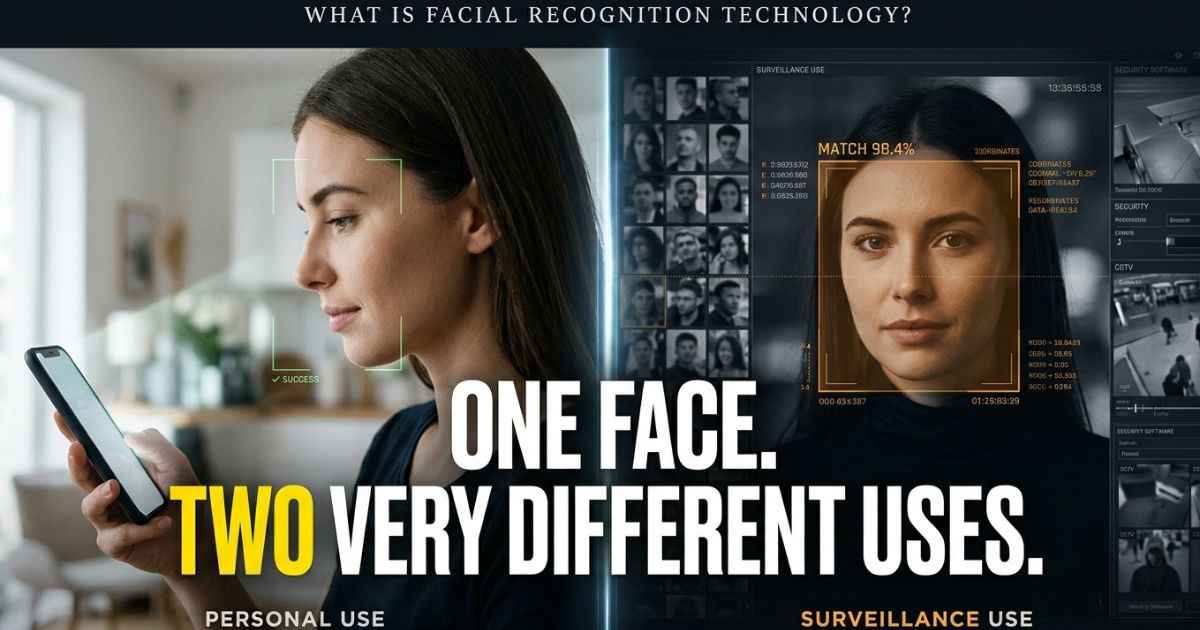
What is facial recognition technology? It is software that uses a face to check who someone is, or to search for who they might be. A camera captures a face. The software turns it into data. Then it compares that data with one saved face or with a big group of faces.
That one difference matters a lot. Unlocking your phone is not the same as a police search. This guide explains how the technology works, where people meet it, and why it can make mistakes.
Quick answer
- Facial recognition compares a face with one saved face or with many faces.
- A match score is not proof of who someone is.
- Rules for airports and agencies differ, so check the current policy before you act.
What Is Facial Recognition Technology?
Facial recognition is a type of biometric technology. Biometrics uses measurable biological or behavioral traits to recognize or verify someone. Facial recognition uses a biological trait: the face. The Congressional Research Service (CRS) describes it as a way to identify or verify people through measurable facial features.
Those two words have different meanings. To verify means to check that someone is who they say they are. To identify means to work out who an unknown person is.
Experts do not all use one exact definition. Some focus only on matching a person’s identity. Broader definitions also include guessing age or reading emotions.
A simple example is your phone. When you unlock it with your face, the phone checks whether the face in front of it matches the saved owner.
How Does Facial Recognition Technology Work?
Sources divide the facial-recognition process into four or five steps. Microsoft separates image capture and the final decision, while Kaspersky and OneSpan group some steps together. Here is a simple version.
Step 1: Face Detection and Image Capture
A camera takes a photo or a video frame. The software looks for a face in the picture. This step is called face detection.
Finding a face is not the same as knowing whose face it is. The Algorithmic Justice League and CSIS both treat detection and recognition as separate jobs. CSIS also describes facial characterization, which sorts a face by traits like age or emotion. That does not name a person either.
Step 2: Feature Extraction and the Face Template
Next, the software maps measurable parts of the face. This is called feature extraction. The software then turns those measurements into a digital summary of the face.
Sources call this summary a face template or a faceprint. Systems differ. Do not assume every system measures the same points.
Step 3: Face Matching and the Similarity Score
The software compares a new face template with one reference or a gallery of stored templates. The comparison depends on the task. It gives a similarity score. That score shows how alike two faces look to the system.
CSIS warns that people can misread these scores. A high score should not be treated as final proof of identity. CSIS also explains comparison thresholds, which are the cutoffs that decide what counts as a match.
NIST, the US testing agency, tracks two kinds of errors separately. One is a false match. The other is a missed match.
Facial Verification vs. Facial Identification
NIST and the National Academies describe two different jobs. One is one-to-one verification. The other is one-to-many identification.
| One-to-one verification | One-to-many identification | |
|---|---|---|
| The question | Is this person who they say they are? | Who is this unknown person? |
| What it compares | A new face image and one reference image | An unknown face and a larger set of faces |
| Example | Unlocking a phone | Searching a database of faces |
When you read about facial recognition, ask which job the system is doing. The risks and rules can be very different.
What Is Facial Recognition Technology Used For?
People meet this technology in several places. Some uses are personal. Others involve the government or a business.
Smartphones and Personal Devices
Phones use facial recognition to unlock. Kaspersky, Microsoft, and OneSpan all describe this use. It is usually one-to-one verification, because the phone checks for one owner.
Airports and Border Control
CRS describes a Department of Homeland Security (DHS) final rule published on October 27, 2025. It took effect on December 26, 2025. The rule expanded facial recognition use by U.S. Customs and Border Protection (CBP) for noncitizens entering and leaving the United States. This covers airports, seaports, and land crossings.
CRS says use for US citizens is voluntary in the entry and exit programs it describes. It also separates one-to-one verification from one-to-many identification in these processes. Do not assume the same rules apply to every airport, agency, or program.
CBP says officers manually review travel documents when facial comparison fails. In rare cases, travelers may face secondary inspection and delays.
Law Enforcement and Public Safety
Police can use facial recognition to look for possible matches. The Algorithmic Justice League and CRS both discuss this use and its risks. A possible match should be a lead for further work, not proof that someone did something wrong.
The FBI says its facial-recognition searches return potential candidates, not positive identifications. Human reviewers compare the candidates, and agents must investigate further.
A 2021 Government Accountability Office report said federal law enforcement agencies should better assess privacy and other risks.
Banking, Retail, and Other Services
AWS, Microsoft, and CRS mention banking, fraud prevention, and retail. CRS also covers housing, and the Algorithmic Justice League covers employment and housing. The basic steps are the same. The goal changes from one use to the next.
How Accurate Is Facial Recognition Technology?
There is no single answer. Accuracy depends on the system, the test, and the conditions. Be careful with any accuracy number that does not name the system, the test, and the task.
NIST evaluates facial-recognition algorithms submitted by developers. It does not test finished commercial products that use them.
In a 2019 study, NIST tested 189 algorithms from 99 developers. Researchers used four photograph collections containing 18.27 million images of 8.49 million people. Those figures describe that study. They are not one score for every system.
False Positives and False Negatives
| What it means | Plain example | |
|---|---|---|
| False positive | The system says two faces match, but they are different people. | A shopper is flagged as someone else. |
| False negative | The system misses a match that is real. | A phone fails to recognize its owner. |
A real US case shows why this matters. In December 2023, the Federal Trade Commission (FTC) announced a complaint and proposed order against Rite Aid. A stipulated court order filed February 26, 2024, prohibited Rite Aid for five years from using facial-recognition or analysis systems in its retail stores, pharmacies and online retail platforms.
The FTC’s complaint said false matches caused customers to be wrongly flagged. It also said the company did not take reasonable steps to prevent harm. These are the FTC’s claims. They are not a finding about every system.
On the other side, one iPhone user reported that Face ID stopped working after an update. Another user said makeup around the eyes caused failures. These are personal stories, not test results.
Why Image Quality and Testing Conditions Matter
CSIS and CRS both say results depend on how and where a system is used. A lab test is not the same as real life. That is why one system can work well in one setting and poorly in another.
What Are the Benefits of Facial Recognition Technology?
Supporters point to a few benefits. Kaspersky, Microsoft, AWS, and CRS discuss them.
- Speed and convenience: A face scan can be quick to use, such as when you unlock a device.
- Security: Companies say it can help confirm who someone is and help prevent fraud.
- Efficiency: Organizations say it can cut manual work.
Not everyone agrees these gains always count. Some travelers on Reddit ask what a scan adds when an agent can already check an ID.
What Are the Risks and Disadvantages of Facial Recognition?
Kaspersky, the Algorithmic Justice League, Envista, and CRS all discuss risks. They fall into three groups.
Privacy and Mass Surveillance
Using your own face to unlock your phone is a controlled use. Searching for faces in public places is a much broader use. Privacy and surveillance worries are strongest for the second kind.
CRS reports that some state and local governments have passed laws that limit or ban some uses.
Bias and Misidentification
Algorithmic bias means a program may work differently for different groups of people. NIST tests for demographic differences. CSIS and CRS also discuss performance differences. The safest approach is to look at independent test results, not broad claims.
Facial Data Storage and Security
Face data is sensitive. If it is misused or leaked, it can create privacy and security problems. Kaspersky itself discusses these risks.
Travelers also ask a simple question. Is my airport photo stored or linked to my identity? The answer depends on who runs the system and what their policy says. The sources do not show one rule for every scan.
For CBP entry and exit, the 2025 Federal Register rule gives some time limits. Photos of US citizens are destroyed after citizenship is confirmed, no later than 12 hours. Other travelers’ facial images may stay in CBP’s internal cloud for up to 14 days. Certain in-scope traveler photo records can stay in DHS systems for up to 75 years.
Frequently Asked Questions About Facial Recognition Technology
Can I refuse facial recognition at an airport?
It depends on the agency and the program. CRS says use for US citizens is voluntary in the CBP entry and exit programs it describes. Do not assume that applies to every airport or agency. One Reddit user suggests asking before you hand over your ID. That is a user tip, not an official TSA rule, and the current TSA policy was not checked.
Why should I turn off Face ID?
Phone unlocking is a different use from airport or police searches. A phone usually compares your live face with the saved owner. Some users report Face ID problems after updates or changes in appearance, but the cause is not clear. Check official guidance from your device maker before changing settings.
How can I protect myself from facial recognition technology?
Start by learning when a scan is being used. Read the policy of the service or agency. Ask whether another option exists. No one can promise you will avoid every camera.
Can facial recognition be used to find someone?
Yes, in one kind of system. One-to-many identification can search a set of faces for a possible match. The sources do not show a general tool that anyone can use to reliably find a person.
What happens if facial recognition does not match my ID?
A failed match is not proof that you did something wrong. What happens next depends on the agency or service. CBP says officers manually review travel documents when facial comparison fails. In rare cases, travelers may face secondary inspection and delays. One traveler on Reddit asked why a companion’s face did not match an ID after the person looked different. The cause was not settled in that thread.
Current Checks for US Readers
Some facts in this guide can change. Check them again before you rely on them.
| Topic | What the sources say | Check again |
|---|---|---|
| DHS and CBP rule | CRS says a DHS final rule was published on October 27, 2025, and took effect on December 26, 2025. | Every 3 to 6 months |
| TSA opt-out steps | A current TSA policy was not checked. Use an official TSA page. | Before you act |
| State and local laws | CRS reports that some places limit or ban some uses. | Every 3 to 6 months |
| NIST test results | NIST testing is ongoing, so results can change. | At least every quarter |
| Photo storage and deletion | This depends on the company or agency that runs the system. | Check that operator’s policy |
You May Find These Interesting:
What Is Virtual Reality? How It Works, Examples, Uses, and Pros and Cons
What Is Augmented Reality?