
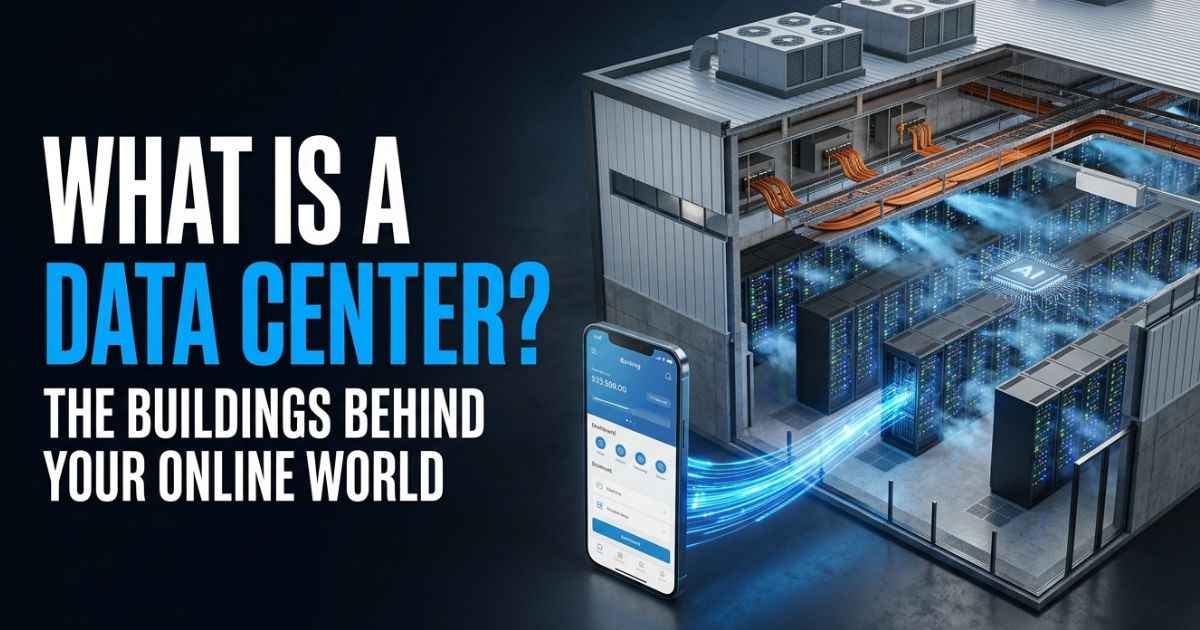
What is a data center? It is a physical space that holds computers, storage drives, and network equipment. It also has the power, cooling, and security systems that keep them running. It can be a dedicated room, a server closet, or a whole building. When you open a banking app or stream a video, a data center is likely doing the work behind the screen.
Most people never see one. Yet these places are now in the news for their electricity use, water use, and effect on nearby homes. This guide explains what happens inside, why it matters, and what is still unknown.
What Is a Data Center Used For?
A data center is a physical place that holds the computers behind online services. Companies use these facilities to run apps and keep information ready to use.
Cisco says a data center does three main jobs:
- Computing: Servers run apps and process information.
- Storage: Drives hold information for later use.
- Networking: Cables and devices connect servers, storage, and users.
These jobs support email, file sharing, databases, business software, video calls, and AI.
How Data Centers Support Everyday Online Activities
Say you check your balance in a banking app. Your request travels over a network to a server in a data center. The server finds your information in storage and sends the answer back to your phone.
Microsoft uses the same idea. It says data centers power our daily lives. You may never think about the building, but your apps depend on it.
How Does a Data Center Work?
Think of a data center as a very busy library with its own power plant and air conditioning. The servers are the workers. The storage is the shelves. The network is the road that carries answers to you.
All of this equipment needs electricity all day. It also gives off heat, and the heat has to go somewhere. That is why power and cooling are part of the building, not extras.
How Servers Process Information
Intel explains the process in a few steps:
- Information moves from storage into memory.
- The CPU runs the app’s instructions. The CPU is the main chip that does the thinking.
- The result goes back out through the network.
You do not need to know more than that to understand the big picture.
Why Data Centers Need Continuous Power and Cooling
Servers cannot run without a steady supply of electricity. They also cannot run well when they get too hot. If either one fails, services can slow down or stop.
Data centers plan for this. They add backup power and cooling equipment so the building can keep working during certain problems.
What Is Inside a Data Center?
A data center has more than computers. The table below shows the main parts and what each one does.
| Part | What it does |
|---|---|
| Servers | Run apps and process information |
| Server racks | Hold several servers in organized cabinets |
| Storage | Holds files, databases, and other digital content |
| Routers and switches | Move information between computers and networks |
| Firewalls | Watch network traffic and block unauthorized connections using security rules |
| UPS | Gives backup power for a short time if electricity is interrupted |
| Generators | Give backup power when the normal supply fails |
| Cooling equipment | Removes heat from the computer equipment |
| Security systems | Protect the equipment and the information |
Servers and Server Racks
Servers are the computers that do the work. AWS says they sit in racks, which are cabinets that hold and organize many servers in one place.
Storage Systems and Networking Equipment
Storage keeps your information. Networking equipment moves it. Routers and switches act like traffic directors. Firewalls monitor incoming and outgoing network traffic. They block unauthorized connections based on security rules.
Power Supply and Backup Generators
Schneider Electric describes a UPS as a system that gives backup power during interruptions. Generators step in when the normal electricity supply fails. Together, they help a facility keep running through an outage.
Cooling and Security Systems
Cooling equipment removes the heat that servers make. Security systems protect both the equipment and the digital side of the facility. That includes controls on who can enter the building.
What Are the Different Types of Data Centers?
Data centers differ in who owns them, who runs them, and how big they are. Here are the main types.
| Type | What it means |
|---|---|
| Enterprise | A company owns and runs a facility for its own needs |
| Colocation | Businesses rent space and support systems for their own equipment |
| Managed services | An outside provider manages equipment for a customer |
| Hyperscale | Very large facilities built for huge computing and storage jobs |
| Edge | Smaller facilities placed closer to users or devices |
Enterprise Data Centers
A bank might run its own facility to keep control of its equipment. That is an enterprise data center. The company owns it and uses it for its own work.
Colocation and Managed Data Centers
In a colocation facility, a business rents space and support systems but brings its own equipment. In a managed setup, an outside provider takes care of the equipment for the customer. The main difference is who handles the day-to-day work.
Cloud and Hyperscale Data Centers
Hyperscale facilities are very large. Cloud providers use them to serve many customers at once. Lenovo and IBM both cover this type in their guides.
Edge Data Centers
Edge facilities are smaller. They sit closer to users or devices. Cisco says this helps reduce the distance data has to travel.
What Is the Difference Between a Data Center and the Cloud?
People often mix up these two terms. They are not the same thing.
| Data center | Cloud | |
|---|---|---|
| What it is | The physical space and equipment | A way to use computing power over the internet |
| Can you visit it? | It is a physical place, but access is restricted. Visitors need prior approval and an authorized escort. | Cloud services are accessed online. |
| How they connect | Holds the machines | Uses those machines to offer services |
Intel explains it this way. A data center is the physical setup. Cloud computing is a service that gives you access to computing resources over the internet. Cloud companies such as AWS, Microsoft Azure, and Google Cloud still rely on physical data centers.
Why Do Data Centers Use So Much Electricity and Water?
Servers run all day, and they make heat. Power and cooling are the two big needs. Water use depends on how a building is cooled.
Why Servers Need Cooling
Servers give off heat when they process information. If the heat builds up, the equipment cannot work as it should. Cooling systems take that heat away.
Intel says cooling can use a large part of a facility’s energy. Its guide gives a typical estimate of 30% to 40%. That is not a rule for every building. Each facility is different.
Air Cooling vs. Liquid Cooling
The Congressional Research Service (CRS) names two broad ways to cool a data center:
| Method | How it works |
|---|---|
| Air cooling | Moves chilled air through the facility |
| Liquid cooling | Uses liquid to carry heat away from equipment |
The best choice depends on the facility’s size, its computing work, its location, its climate, and how much water it can get.
Water use causes a lot of confusion. Some people mix up two things. One is a liquid loop that cools the servers. The other is the larger cooling system for the whole building. Online discussions also show a trade-off. Some designs use more electricity. Others use more water.
CRS lists these things that shape water use:
- The cooling system design
- The size of the facility and its computing work
- Local temperatures and climate
- Access to water
- Regional water supply and competing demand
Many facilities get water from city systems. Others can use reclaimed wastewater, surface water, or groundwater. One analysis cited by CRS estimates that city water systems supplied 97% of US data centers’ on-site water needs as of 2025.
There is one more thing to know. CRS says facility-level water data is limited. It also says the federal government has not done a systematic nationwide study of data center water use. So no single water number fits every data center.
Still, CRS shares one example. An IEA estimate says a 100-MW US data center may directly consume about as much water each day as 2,600 households. MW stands for megawatts, a measure of power. This is an example, not a number for every site.
How Much Electricity Do US Data Centers Use?
The Lawrence Berkeley National Laboratory (LBNL) published its latest US report in June 2026. Its numbers use a unit called TWh. That stands for terawatt-hours, a way to measure very large amounts of electricity.
LBNL estimated US data center electricity use at 192 TWh in 2024. That was 4.7% of US electricity use. Its report excludes cryptocurrency mining.
| Measure | Estimate |
|---|---|
| US data center use in 2024 | 192 TWh |
| Share of all US electricity in 2024 | 4.7% |
| Projected use in 2030 (reference case) | 649 TWh |
| Projected share in 2030 | 11.8% |
| Range for 2030 | 9.5% to 15.3% (521 to 843 TWh) |
The 2030 numbers are projections. They are not measured results. LBNL’s estimates change with the number of servers shipped, special AI chips, how long AI servers last, and how busy servers are.
Can a Data Center Affect the Area Around It?
It can, but the effects differ from place to place. Some neighbors report problems. Others say they barely notice a facility. Official sources show that water, electricity, and local planning can all raise questions.
Here is a fair look at both sides.
| Possible benefit | Possible concern |
|---|---|
| Supports online services, businesses, and science | Needs a lot of electricity |
| Large projects can support construction, operations, and supplier jobs | Cooling can put pressure on local water |
| Backup systems help keep services running | Generators, cooling equipment, and construction can affect neighbors |
| Economic effects depend on project size and local conditions | Land use, noise, and power lines can lead to local disputes |
These are possible results. They do not happen at every site.
Noise, Lighting, and Construction Activity
Noise is a common worry, but the answer is not simple. A former data center worker said his traditional facility was loud inside but barely audible outside. He credited its soundproofing and insulation. That is one person’s report, not a rule.
Construction can be a different story. A local news excerpt shared in r/nova reports that a Reston resident described drilling, blasting, metal work, digging, and bright lights at night. Those details come from the resident quoted in the shared report, not from Reddit commenters. Confirm them with the original report before you act on them. So noise during construction can differ from noise during normal use.
Water and Electricity Concerns
Residents sometimes worry about water pressure and power bills. Whether a facility affects either one depends on local factors. For electricity, these include supply deals, grid capacity, how costs are shared, and choices made by the local utility. It would be wrong to say every nearby home pays more.
Questions to Ask About a Proposed Data Center
If a data center is planned near you, you can ask a few clear questions:
- How will the building be cooled, and where will its water come from?
- How much electricity will it need, and who pays for new power lines?
- What backup equipment, such as generators, will it use?
- What are the rules on noise and lighting?
- When are the local planning meetings?
One online discussion advises people to check local planning and rezoning notices. That is good advice. Homeowners also ask about resale value. Replies in those threads are opinions. Nothing in this research proves that a data center raises or lowers home values.
Current Checks
Some facts in this guide change often. Check these first when you update it.
| Fact | Current figure | Source | Check when |
|---|---|---|---|
| US data center electricity use, 2024 | 192 TWh (4.7% of US electricity); excludes cryptocurrency mining | LBNL 2025 Update, hosted by the US Department of Energy | LBNL issues a new report |
| Projected use, 2030 | 649 TWh (11.8%); range 9.5% to 15.3% | LBNL, June 2026 | At least every six months |
| Water use data | Facility-level data is limited | CRS, July 31, 2026 | New research or disclosures |
| Energy data study | On March 25, 2026, EIA announced three voluntary pilot studies. It identified 196 companies operating data centers in Texas, Washington state, and the Northern Virginia and Washington, DC region. | EIA, March 2026 | New EIA results |
Frequently Asked Questions About Data Centers
What is a data center in simple words?
A data center is a physical space that holds computers, storage, and network equipment. It also has the power, cooling, and security needed to run them. It can be a dedicated room, a server closet, or a whole building. Websites, apps, and online services depend on places like this.
Who owns and controls a data center?
It depends on the type. A company can own its own facility. Other businesses rent space in a colocation center, or pay a provider to manage their equipment. Cloud companies run very large facilities and serve many customers.
What does a data center look like?
Inside, you find rows of server racks, lots of cables, cooling equipment, and power systems. The building often looks plain from the outside. A nearby homeowner in one online thread first thought a data center under construction was a warehouse.
Are all data centers noisy?
No. One former worker said his traditional facility was loud inside but barely audible outside. He credited its soundproofing and insulation. Equipment and design differ, and construction noise is not the same as everyday noise.
Can a data center affect nearby homes?
It can in some cases. People raise concerns about noise, lights, water, and electricity. No source in this research shows what happens to home prices, so it is best to check local plans and ask questions.
Are data centers dangerous?
There is no simple yes or no. It is better to look at specific issues. These include electricity use, water use, backup generators, and noise. Each one depends on how a facility is built and run.
What is a data center for AI?
It is a data center that runs AI work. LBNL says specialized computing hardware is a major reason electricity demand is rising. Intel also points to GPUs, which are chips used for special computing jobs such as AI.
You May Find These Interesting:
How Does Fingerprint Scanning Work?
What Is Facial Recognition Technology? A Simple Guide