
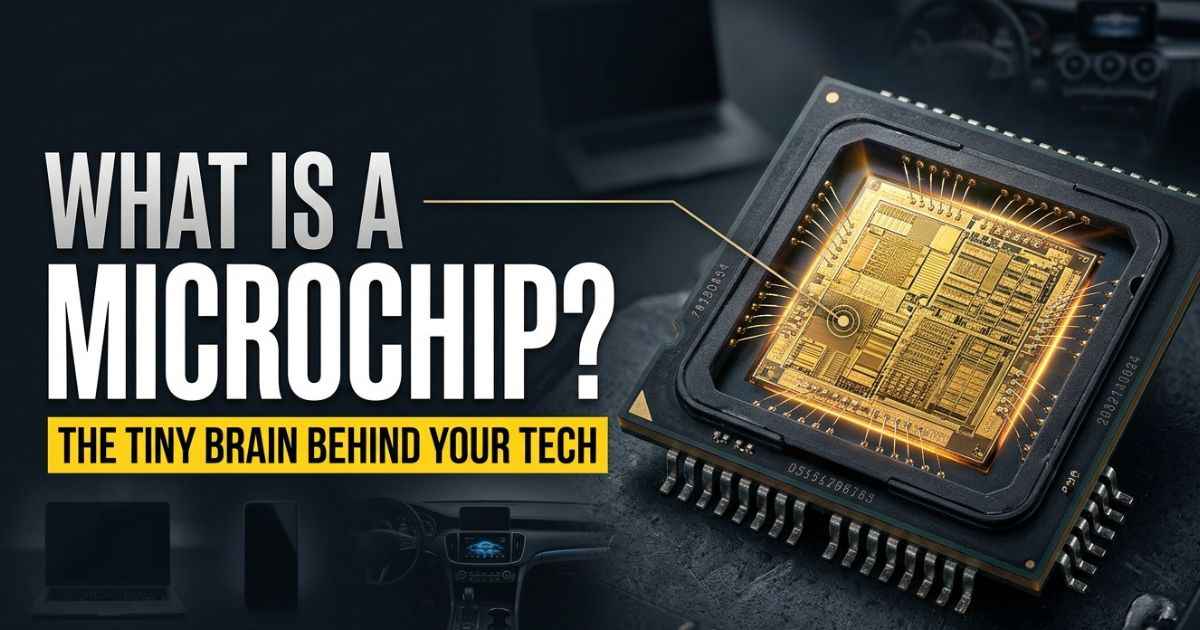
A microchip is a tiny electronic circuit built on semiconductor material, usually silicon. Its parts work together to process, control, or store information. People also call it an integrated circuit.
Here is the part that trips people up. Not every microchip is a processor. Some chips think, some remember, and some sense the world around them. Below, you will see what is inside a chip, how it works, and how it differs from a circuit board.
What Is a Microchip?
A microchip is a tiny electronic circuit built on semiconductor material, usually silicon. The circuit can hold parts like transistors, resistors, and capacitors. Some modern chips contain millions or billions of transistors, alongside other components.
Think of a chip as a very small city. Each part has a job, and wires link them so they can work as a team.
Is a Microchip the Same as an Integrated Circuit?
Yes, for most everyday talk. An integrated circuit (IC) is a small circuit with several linked parts on one chip. “Microchip,” “chip,” and “computer chip” are common names for it.
“Semiconductor” is a little different. That word names a material whose electrical flow can be controlled. A chip is a finished product that uses that material.
What Is Inside a Microchip?
Inside a chip, you will find a base material and many tiny electronic parts. The base is usually silicon. The parts include transistors, resistors, and capacitors, all joined into one circuit.
Why Is Silicon Used in Microchips?
Silicon is a semiconductor. That means its electrical flow can be adjusted. Sometimes it lets current pass, and sometimes it blocks it. That control is what makes a chip useful.
Silicon is the most familiar chip material, but it is not the only one. Germanium is another semiconductor material. Some chips use compound semiconductors. So say “usually silicon,” not “always silicon.”
What Does a Transistor Do?
A transistor is a tiny electrical switch. It can turn current on or off. It can also boost a signal.
A light switch is a good comparison. Flip it one way and the light is on. Flip it the other way and it is off. Modern digital chips can contain huge numbers of transistor switches, and they work together. Simpler integrated circuits may contain only a few.
Do chips always have billions of them? No. An integrated circuit can have anywhere from several transistors to billions.
CMOS technology uses two types of transistors working together. This helps reduce power use in several modern chips.
How Does a Microchip Work?
In a digital microchip, transistors switch electrical signals between high and low states. Analog chips handle continuously changing signals. Some transistors also amplify those signals. Wires carry the signals from one part to the next. Together, the parts can do a task, such as adding numbers or saving data.
Here is a simple picture of a digital chip:
- An electrical signal enters the chip.
- Transistors switch it between high and low along the way.
- The linked parts follow that pattern to finish the task.
- The chip sends out a result.
How Does a Microchip Read 0 and 1?
Digital chips treat certain voltage ranges as high signals (1) and other ranges as low signals (0). People in discussion forums often explain this as voltage levels.
Back to the light switch. “On” is like 1. “Off” is like 0. A chip checks these levels very fast and uses them to follow its instructions.
Do All Microchips Use Binary?
No. Digital chips use high and low signal states. Analog chips handle signals that change smoothly over a range. Mixed-signal chips do both.
So the idea that every chip is just a pile of on and off switches is incomplete. It describes digital chips well, but not all chips.
What Are the Main Types of Microchips?
Chips come in several types because they do different jobs. Here are the main kinds of microchips.
| Type | What it does |
|---|---|
| Logic | Processes information and follows instructions |
| Memory | Holds information |
| ASIC | A chip designed for a specific application |
| SoC | Puts several system functions on a single chip |
This is why calling every chip a “tiny computer” is misleading.
The Semiconductor Industry Association groups semiconductor components into six categories. Note that discrete components are individual devices, not integrated microchips.
| Category | What it does |
|---|---|
| Logic | Processes information and follows instructions |
| Memory | Holds information |
| Analog | Works with signals that vary smoothly |
| Sensors and actuators | Sense the world or cause action |
| Optoelectronics | Works with light and electronics |
| Discrete components | Single parts, such as one transistor. These are individual devices, not integrated microchips |
Logic Chips and Memory Chips
Logic chips do the thinking. A CPU is a well-known example. Memory chips hold information.
There are two common memory types. DRAM is working memory, and it is volatile. That means it needs power to hold data. NAND Flash is nonvolatile. It keeps stored data even when the device is switched off.
Picture your phone. The logic chip runs the app you open. DRAM holds what the app is using right now. NAND Flash keeps your saved files.
Analog and Mixed-Signal Chips
Analog chips work with signals that change smoothly, not just high and low. Mixed-signal chips combine analog and digital parts on one chip.
ASICs and Systems-on-a-Chip
An ASIC (application-specific integrated circuit) is a microchip designed for a specific application. It can combine several functions within that application. A system-on-a-chip (SoC) puts several system functions on a single chip.
What Are Microchips Used For?
Microchips are in smartphones, computers, cars, and medical equipment. Each device needs chips that do different jobs. Some process data, some store it, and some sense things or work with light.
Because chips come in several types, one device often holds more than one kind.
How Are Microchips Made?
Making a chip takes several careful stages. These are the six steps imec describes:
- Purify the silicon. Raw silicon is cleaned and prepared.
- Build layers. This step is called deposition. Thin layers are added one on top of another.
- Print the pattern. Photolithography moves the circuit pattern onto the layers using light.
- Remove extra material. Etching takes away the parts that are not needed.
- Change the electrical behavior. Doping adjusts how parts of the silicon carry current.
- Test, cut, and package. Finished chips are checked, cut apart, and placed in protective packages.
Steps two through five repeat hundreds of times to build the transistors and metal pathways connecting them.
From Silicon to a Wafer
A wafer is a thin piece of semiconductor material. Many chips are built on one wafer. Later, the wafer is cut into separate chips.
Photolithography, Etching, and Doping
These three steps shape the circuit. Photolithography draws the pattern. Etching carves it out. Doping tunes how the silicon behaves. Chipmakers also work in cleanrooms, which are tightly controlled spaces.
Testing, Cutting, and Packaging
Each cut-out piece is called a die. The die is the actual chip before it gets its cover. Packaging adds a protective shell and the connections that link the die to other parts.
Microchip vs. Processor vs. Circuit Board: What’s the Difference?
These three things are often mixed up. A microchip is the broad category. A processor is one kind of chip. A circuit board is something else entirely, because chips sit on it.
| Term | What it is |
|---|---|
| Die | The actual silicon chip, before it is packaged |
| Package | The protective shell and connections around the die |
| Microchip | The finished chip, with its circuit inside the package |
| CPU (processor) | One type of logic chip that follows instructions |
| PCB (printed circuit board) | The larger board that holds chips and other parts |
A forum user once asked if a microchip is like a circuit built on a breadboard, only smaller. The answer showed the key difference. The silicon die sits inside the package. The big green board you often see is the PCB.
So a CPU is a microchip, but a microchip is not always a CPU. And a circuit board holds chips. It is not a chip itself.
What Are Microchips Good At, and What Are Their Limits?
What chips do well:
- They fit a whole circuit with a huge number of parts into a small space.
- They come in types that fit different jobs, from storing data to sensing.
- They can be built for a specific application, as ASICs are.
Where chips run into limits:
- Making them takes several detailed steps. Lam Research says manufacturing a chip can take more than three months and involve nearly 700 steps. These figures describe its manufacturing example, not every chip.
- Memory chips mainly store information, while logic chips mainly process it. However, some chips combine several functions. Processors can also contain memory, such as cache.
- They need other parts. Chips usually sit on a circuit board with other components.
What About Pet Microchips?
The word “microchip” also names a different device. A pet microchip is a small identification device placed under an animal’s skin. It stores an ID number linked to a registry. A scanner reads that number.
It is not a computer processor. It also does not track location, because it has no GPS. If you want details on pet microchips, check a vet or the American Animal Hospital Association.
Current Checks
Some details change over time. Check these before you rely on them.
| Detail | Why to check |
|---|---|
| Transistor counts in specific chips | New chip generations can have different counts |
| Manufacturing step counts and times | They vary by maker and product |
| Pet microchip details | AAHA last updated its pet microchip FAQ on May 19, 2026 |
Microchip FAQs
What is the difference between a microchip and a CPU?
A CPU is one type of microchip. It is a processor that follows instructions. Other chips store data, sense things, or work with light. So a CPU is a chip, but not every chip is a CPU.
Do all microchips have billions of transistors?
No. An integrated circuit can have from several transistors to billions. Some modern chips have millions or billions. Others have far fewer.
Do all microchips use binary?
No. Digital chips use high and low signals that stand for 1 and 0. Analog chips handle smoothly changing signals. Mixed-signal chips use both.
What is a microchip made of?
A microchip is usually made on silicon. It holds parts like transistors, resistors, and capacitors. Germanium and compound semiconductors are other possible materials.
Do microchips still exist?
Yes. ASML and the Semiconductor Industry Association both describe microchips and integrated circuits as basic parts of modern electronics. They are still used in devices like phones, computers, cars, and medical equipment.
Is a pet microchip the same as a computer microchip?
No. A pet microchip gives out a registered ID number when scanned. It is not a processor, and it cannot track location like GPS.
You May Find These Interesting:
How Does 5G Technology Work?
What Is Blockchain Technology? A Simple Guide to How It Works