
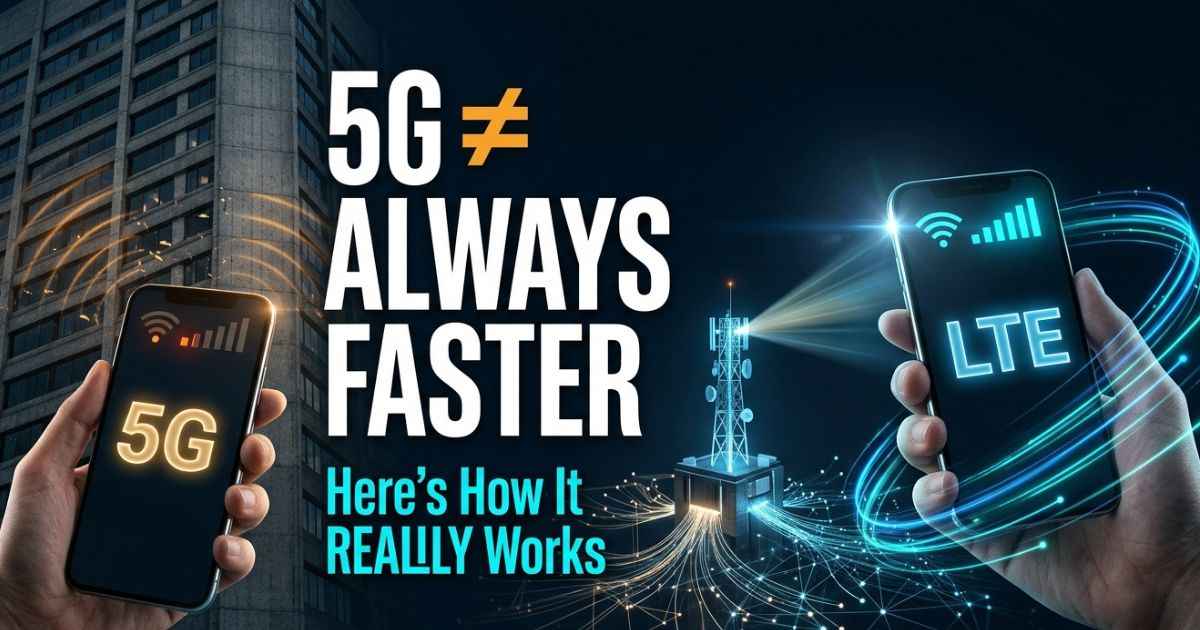
So, how does 5G technology work? Your phone sends radio signals to a nearby cell site. The cell site passes your request to the core network, which sends it on to the internet. The answer returns the same way. Different radio bands and smart antennas help the network carry more data.
A 5G icon on your screen does not promise fast speeds, though. This guide shows each step. Then it explains why 5G can sometimes be slower than LTE.
How Does 5G Work on Your Phone?
Think of 5G as a trip with five stops. Each time you open a website or app, your request makes this trip. The answer then travels back to your phone. Idaho National Laboratory has a simple FAQ on this path.
- Your phone sends and receives digital information with its radio equipment.
- A 5G radio connection links your phone to a nearby cell site using radio waves.
- The cell site receives the signal and connects your phone to the mobile network.
- Backhaul and the core network carry the data onward. The core network helps send it to the right place.
- The internet answers your request. The reply travels back through the network to your phone.
Your Phone Sends a Radio Signal
Your phone has radio equipment and an antenna. It turns your tap or search into digital data. Then it sends that data out as radio waves.
The 5G Cell Site Receives the Signal
A cell site is a location that holds cellular antennas and equipment. The base station is the radio equipment that communicates with your phone. The site’s antennas pick up the signal from your phone. The site then links your phone to the mobile network. The radio link between your phone and the cell site is called 5G New Radio, or 5G NR.
Backhaul Connects the Cell Site to the Core
Backhaul is the connection between a cell site and the rest of the network. It can use fiber-optic cables or wireless links, such as microwave radio. Think of it as the road that leaves the cell site. The radio signal is only one part of your connection. Backhaul and the core network carry the rest of the trip. Small cells connect to the wider network through backhaul. This may use fiber-optic cables or wireless links, depending on the location. The GSMA backhaul overview explains more.
The Core Network Routes the Data
The core network manages connections and sends traffic where it needs to go. It helps your request reach the website or app you want. Then it helps the reply find its way back to you.
What Makes 5G Different From 4G?
5G is the fifth generation of cellular technology. It changes the radio link and how the network is built. Here is what the sources say.
| What changes | What it means for you |
|---|---|
| Faster potential data speeds | 5G is built to move data faster. Your own speed depends on several things. |
| More network capacity | The network is designed to serve more connections. |
| Lower latency targets | Latency is the time it takes data to travel from a sender to a receiver. Lower latency means less delay. |
| New radio and network design | 5G NR improves the radio link. The core network is also organized differently. |
5G did not start from nothing. Qualcomm explains that both 5G and 4G LTE use a method called OFDM. 5G NR adds improvements on top of it.
Peak Speed vs. Everyday Speed
Standards groups set goals for 5G. The ITU is a United Nations group that works on telecom standards. In ITU-T Recommendation Y.3106, it lists a peak data rate target of 20 Gbit/s. That means 20 gigabits per second, which is the top speed in perfect conditions.
The ITU lists 100 Mbps as a user-experienced target for wide-area coverage, such as urban and suburban areas. Hotspots have a separate target of up to 1 Gbps indoors. The ITU also lists a latency target of 1 ms over the air.
These are goals, not promises. None of these numbers tells you what your phone will get at your address.
How Do 5G Frequency Bands Work?
Radio waves travel on different frequencies. Radio spectrum is the full range of these frequencies. 5G does not use just one. NIST, a US research agency, explains that higher frequencies can offer more bandwidth and capacity. Bandwidth is the room a signal has to carry data. NIST also says 5G uses lower frequencies too.
| Band | What the sources support | In plain words |
|---|---|---|
| Low-band | 5G can use lower frequencies. | These signals can cover wider areas. They do not always give the top 5G speeds. |
| Mid-band | These frequencies sit between low bands and the highest bands. | They balance coverage and capacity. |
| High-band (mmWave) | Higher frequencies can offer more bandwidth. They behave differently when traveling. | They can be very fast, but only in limited areas. Buildings and other obstacles make them harder to use. |
In its 5G spectrum paper, GSMA describes low-band as below 1 GHz, mid-band as 1 to 8.4 GHz, and high-band as above 24 GHz. GHz is short for gigahertz, a unit of frequency.
Low-Band 5G
Lower-frequency signals can reach across broader areas. That helps with coverage. It does not always mean the fastest speeds.
Mid-Band 5G
Mid-band sits in the middle. It can give a balance of coverage and capacity. The exact result depends on the frequency and how the network is built.
High-Band 5G and mmWave
High-band 5G is often called mmWave, short for millimeter wave. Higher frequencies can carry more data. But they do not pass through obstacles as easily. So very fast connections may show up in limited areas.
Not all 5G is mmWave. Do not assume every 5G connection works this way.
What Technologies Make 5G Work?
Some of these tools improve the radio link. Others help run the network. We will keep them apart.
OFDM
OFDM organizes data across multiple closely spaced subcarriers. Think of one wide road split into several narrow lanes. The data travels in all lanes at once. AWS and Qualcomm both explain this method.
Small Cells
Small cells are smaller cell sites. Networks add them to increase capacity in chosen places. Small cells connect to the wider network through backhaul. This may use fiber-optic cables or wireless links, depending on the location.
Massive MIMO and Beamforming
Massive MIMO uses multiple antenna elements to handle several data streams. Beamforming points a radio signal toward certain devices or areas. NIST studies beamforming as part of its 5G research.
Put together, more antennas can carry more streams. Beamforming helps aim them.
Network Slicing
Network slicing splits one network into virtual parts. Each part can meet different needs. This is a network management feature. It is not a type of radio wave. The 5G core network also belongs in this group, since it manages connections and routes traffic.
Why Is 5G Not Always Faster Than LTE?
People ask this a lot. Five Reddit threads show the same pattern. These are personal reports, not lab tests. They do not show how common each problem is.
- A user north of Dallas on r/tmobile said 5G had usually been fast. Lately it had become slower than 4G LTE.
- A user on r/Visible reported about 50 Mbps on 5G and about 170 Mbps on LTE.
- An iPhone 15 Pro user on r/ATT could not get coverage inside a Whole Foods store.
- A user on r/verizon said 5G Ultra Wideband was unreliable inside a work building while LTE worked.
- A user on r/iphone asked whether to use 5G or LTE. They said 5G was bad and battery life was awful on their previous Samsung Galaxy S21+.
A 5G icon usually means your carrier’s 5G network is available, according to Apple. It does not guarantee a strong signal or fast connection. Here are some possible reasons, based on the sources. We cannot say which one explains any single complaint.
| Possible factor | Why it matters |
|---|---|
| The 5G band you are on | Different frequencies behave differently, as NIST explains. |
| Walls and other obstacles | The FCC says its coverage map shows outdoor or in-vehicle coverage, not indoor coverage. |
| Cell-site capacity | The FCC lists cell-site capacity as one thing that changes real results. |
| Location and terrain | The FCC names terrain. Users also report results that change from place to place. |
| Your phone | Users reported different results on different devices and in different places. |
One Reddit participant suggested trying both 5G and LTE. For a fair comparison, test them on the same phone, in the same place, close in time. Others switch to LTE when 5G is poor. These are user tips, not guaranteed fixes.
What Are the Advantages and Disadvantages of 5G?
Advantages
- Higher potential data speeds
- More network capacity
- Lower latency targets
- Support for different kinds of connected devices and uses
Disadvantages
- Coverage is not the same everywhere.
- Some high-frequency signals are harder to receive through obstacles.
- A 5G icon does not guarantee higher speeds than LTE.
- Some areas may not have the same network features as others.
How Can You Check 5G Coverage Where You Live?
The FCC National Broadband Map includes mobile 5G-NR coverage. Providers submit that data using propagation models. Here is a quick way to use it.
- Look up your address on the FCC National Broadband Map and check the mobile coverage.
- Compare it with your mobile provider’s own coverage information.
- Remember that the map shows outdoor or in-vehicle coverage. It does not promise a signal inside a building.
Current Checks
These facts change over time. Review them often.
| Item | What we know | Source and date |
|---|---|---|
| US population with 5G-NR availability | About 95.2% at the report’s 35 Mbps download and 3 Mbps upload level | FCC 2026 Section 706 Report, released August 2026, using data as of June 2025 |
| US land area with qualifying service | About 39% | FCC 2026 Section 706 Report, using data as of June 2025 |
| US road miles with at least one qualifying 5G-NR provider | About 69.2% | FCC 2026 Section 706 Report, using data as of June 2025 |
| How often providers update map data | Providers submit data based on June 30 and December 31 snapshots | FCC |
| Carrier band deployments, standalone 5G, typical speeds | Vary by provider and place. We did not check current carrier details. | Check your provider’s official pages |
Population coverage and land coverage are different things. Most people can live in places with modeled 5G availability. That does not mean 5G reaches every road, rural area, or indoor room. These are modeled numbers, not proof of service at your address.
Frequently Asked Questions About 5G
Why can’t 5G penetrate walls?
Not all 5G has this problem. Higher frequencies can carry more data, but buildings and other obstacles make them harder to receive. The FCC also says its map shows outdoor or in-vehicle coverage. So a map can show 5G near you while your signal inside is weak.
Why are people turning off 5G?
Several users reported slow 5G compared with LTE. Others reported weak indoor signal or poor battery life. Some said they switch to LTE in certain places. If you try this, compare both settings in the same spot.
Does 5G drain your phone battery?
It depends on the phone and the situation. One user on r/iphone said battery life was awful on their previous Samsung Galaxy S21+. Apple says its 5G On setting may reduce battery life. Its 5G Auto setting can switch to LTE when 5G offers no noticeable improvement.
What is the downside of 5G Wi-Fi?
People sometimes use “5G Wi-Fi” to mean Wi-Fi on the 5 GHz band. This is different from cellular 5G. Idaho National Laboratory explains the difference between 5G and Wi-Fi. The main downside of 5 GHz Wi-Fi is shorter range and weaker wall coverage than 2.4 GHz Wi-Fi.
Does 5G mean unlimited data?
No. 5G describes the network technology. It does not set how much data your plan includes. Check your plan terms with your provider.
What does 5G stand for?
5G stands for the fifth generation of cellular technology. It follows earlier generations such as 4G LTE.
You May Find These Interesting:
What Is Blockchain Technology? A Simple Guide to How It Works
BagelTechNews.com Tech News: What the Site Covers and How Reliable It Is